
Asset Lifecycle Management Concepts Every Student Should Master
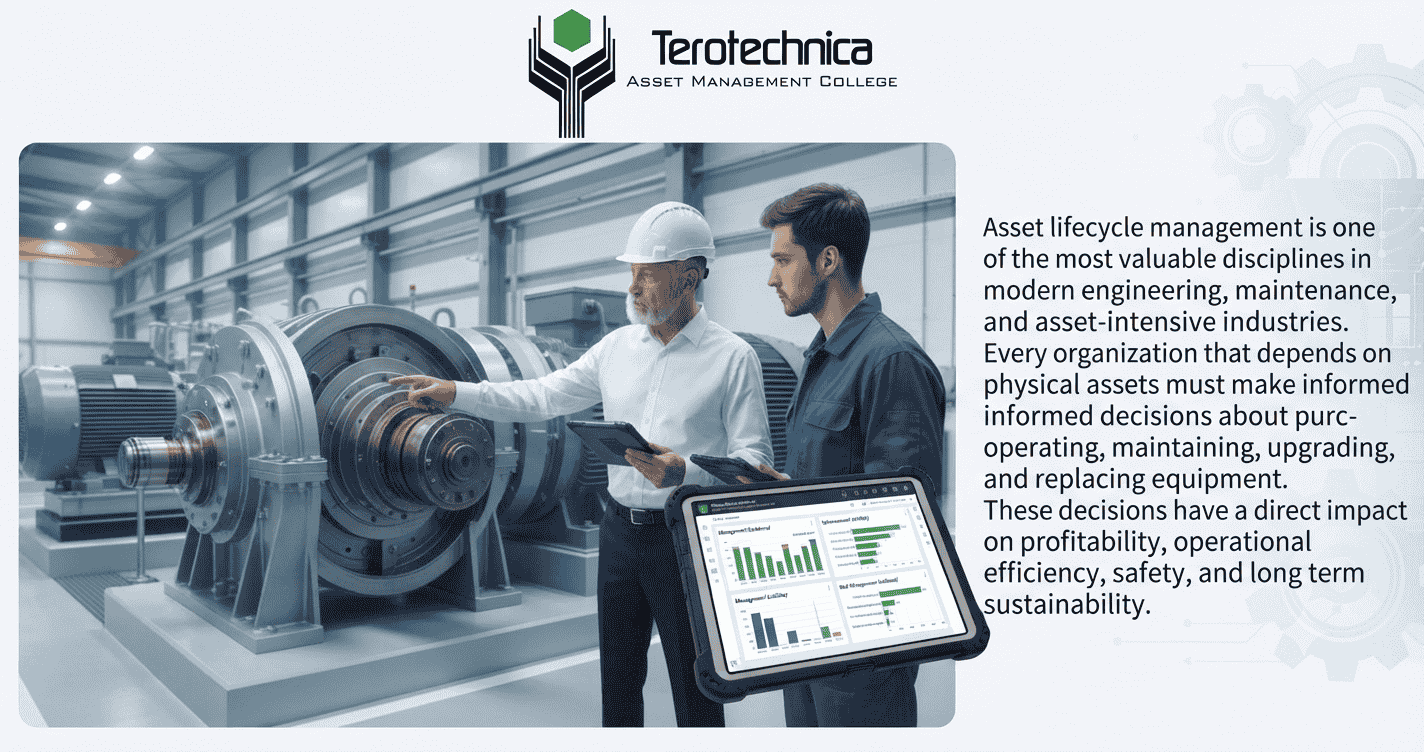
Asset lifecycle management is one of the most valuable disciplines in modern engineering, maintenance, and asset-intensive industries. Every organization that depends on physical assets must make informed decisions about purchasing, operating, maintaining, upgrading, and replacing equipment. These decisions have a direct impact on profitability, operational efficiency, safety, and long term sustainability.
For students preparing for careers in asset management, maintenance engineering, reliability engineering, or industrial operations, understanding asset lifecycle management is essential. It is not simply about maintaining equipment after it has been installed. Instead, it involves making informed decisions from the earliest stages of planning until the asset reaches the end of its useful life.
At Terotechnica, we believe that mastering these concepts prepares students to make strategic decisions that create lasting value for organizations while reducing unnecessary costs throughout an asset's lifetime.
Understanding Asset Lifecycle Management
Asset lifecycle management is the systematic process of managing physical assets from the initial concept through design, acquisition, operation, maintenance, renewal, and eventual disposal or replacement. Rather than viewing equipment as a one time purchase, lifecycle management considers every stage that contributes to its total cost and overall performance.
Every decision made during an asset's life affects future expenses, reliability, productivity, and operational success. This comprehensive approach helps organizations maximize return on investment while minimizing risks and unexpected costs.
Students who understand this philosophy develop the ability to evaluate equipment based on long term value instead of simply comparing purchase prices.
The Complete Asset Lifecycle
One of the first concepts students should master is the complete lifecycle of an asset.
The lifecycle begins long before equipment is purchased. It starts with identifying a business need and determining whether a new asset is the right solution. Engineers and designers then develop concepts, prepare detailed designs, evaluate alternatives, and build prototypes where necessary.
Once the asset is acquired, attention shifts toward installation, commissioning, operation, maintenance, performance optimization, and continuous improvement. Eventually, aging equipment reaches a point where replacement becomes more economical than continued maintenance. At this stage, organizations evaluate retirement strategies and replacement planning.
Understanding every stage allows professionals to make decisions that improve performance throughout the asset's useful life rather than focusing on isolated maintenance activities.
Why Early Design Decisions Matter
Many students assume that maintenance costs begin once equipment is installed. In reality, a significant portion of an asset's lifetime costs are determined during the design phase.
Design choices influence energy consumption, maintenance accessibility, spare parts availability, reliability, safety requirements, and expected service life. Poor design decisions often create expensive operational challenges that continue for decades.
Engineers who understand lifecycle management recognize that investing additional effort during the planning and design stages often results in substantial savings throughout the operational life of the asset.
This mindset encourages proactive thinking instead of reactive problem solving.
Life Cycle Costing
Life cycle costing is one of the most important principles in asset management education.
Instead of evaluating equipment based solely on its purchase price, life cycle costing examines every cost associated with owning and operating an asset.
These costs may include planning expenses, design activities, procurement, transportation, installation, commissioning, maintenance, repairs, energy consumption, downtime, operator training, spare parts, upgrades, disposal, and replacement.
When students learn how to calculate these costs accurately, they gain a much clearer understanding of the true financial impact of investment decisions.
Organizations that apply life cycle costing often avoid purchasing equipment that appears inexpensive initially but becomes costly over time due to poor reliability or excessive maintenance requirements.
Engineering Economics
Engineering economics provides the financial foundation for asset lifecycle management.
Students should understand concepts such as the time value of money, annual compounding, present value, future value, depreciation, and investment analysis.
These principles help engineers compare competing investment opportunities while considering both current expenditures and future financial returns.
Engineering economics enables professionals to justify capital investments using objective financial analysis rather than assumptions or personal preferences.
This skill is highly valued because every asset management decision ultimately affects an organization's financial performance.
Comparing Investment Alternatives
Organizations frequently face multiple equipment options with different purchase prices, maintenance requirements, operating costs, and expected service lives.
Students must learn how to compare these alternatives objectively.
A lower purchase price may seem attractive initially, but higher maintenance expenses or shorter service life could result in greater total ownership costs.
Lifecycle analysis provides structured methods for evaluating competing investments while balancing cost, reliability, performance, and long term operational value.
Understanding these evaluation techniques allows future professionals to recommend solutions that deliver sustainable financial benefits.
Reliability and Maintenance
Maintenance plays a central role in asset lifecycle management.
Students should understand that maintenance is not simply repairing equipment after failure. Modern maintenance strategies focus on preventing failures, improving reliability, extending asset life, and reducing operational disruptions.
Preventive maintenance, predictive maintenance, condition monitoring, reliability centered maintenance, and risk based maintenance all contribute to maximizing equipment performance.
An effective maintenance strategy minimizes downtime while controlling maintenance expenditure throughout the asset's operational life.
Professionals who understand reliability engineering can identify recurring failure patterns and implement improvements before major problems occur.
Equipment Replacement Decisions
One of the most challenging concepts in asset management is determining the right time to replace equipment.
Replacing equipment too early may waste valuable capital, while waiting too long often results in rising maintenance costs, lower productivity, and increased operational risks.
Students should learn how to evaluate replacement decisions using engineering economics, depreciation analysis, maintenance history, operating costs, and remaining useful life.
Understanding these principles enables organizations to replace assets when doing so provides the greatest economic benefit rather than relying on intuition.
Managing Risk Throughout the Lifecycle
Every asset carries operational, financial, environmental, and safety risks.
Effective lifecycle management identifies these risks early and develops strategies to reduce their impact.
Risk assessment involves evaluating the likelihood of equipment failure, the consequences of downtime, potential safety hazards, environmental considerations, and regulatory compliance requirements.
Students who understand risk management can contribute to safer workplaces while protecting organizational assets and maintaining operational continuity.
Dealing with Uncertainty
Real world asset management rarely follows perfect predictions.
Unexpected equipment failures, changing market conditions, inflation, technological advances, and fluctuating operating demands all introduce uncertainty.
Students should learn how uncertainty influences lifecycle cost calculations and investment decisions.
Sensitivity analysis, scenario planning, and probability based evaluation techniques help organizations prepare for different future outcomes.
Developing these analytical skills improves confidence when making complex asset management decisions under uncertain conditions.
Data Driven Decision Making
Modern asset management increasingly depends on accurate data.
Organizations collect information from maintenance records, inspection reports, operational performance, condition monitoring systems, and financial reports to support informed decisions.
Students should become comfortable interpreting asset data and using it to identify trends, forecast maintenance needs, and evaluate equipment performance.
Data driven decision making improves accuracy while reducing reliance on assumptions.
As digital technologies continue to evolve, professionals with strong analytical skills become even more valuable.
Sustainability in Asset Management
Sustainability has become an important consideration throughout the asset lifecycle.
Organizations seek equipment that consumes less energy, produces lower emissions, requires fewer resources, and generates less waste.
Lifecycle management helps evaluate environmental impacts alongside financial performance.
Students who understand sustainable asset management contribute to responsible business practices while helping organizations achieve environmental objectives without sacrificing operational efficiency.
Cross Functional Collaboration
Successful asset lifecycle management requires collaboration across multiple departments.
Engineers, maintenance professionals, financial analysts, procurement teams, operations managers, and senior leadership all contribute to asset related decisions.
Students should appreciate the importance of effective communication and teamwork when managing complex assets.
The ability to explain technical recommendations in financial and operational terms makes professionals far more effective within multidisciplinary organizations.
Building Practical Skills
Theoretical knowledge alone is not enough.
Students benefit from solving practical case studies, analyzing real asset data, performing lifecycle cost calculations, evaluating replacement scenarios, and applying engineering economic principles to actual business situations.
Practical learning develops confidence and prepares graduates for workplace challenges where decisions often involve balancing technical performance, financial constraints, and operational priorities.
Terotechnica emphasizes developing both conceptual understanding and practical application so students are prepared for professional responsibilities immediately after completing their studies.
Preparing for Industry Expectations
Industries such as mining, manufacturing, transportation, utilities, infrastructure, oil and gas, and public services all depend on effective asset lifecycle management.
Employers increasingly seek graduates who understand how assets contribute to business performance rather than focusing solely on maintenance activities.
Professionals who master lifecycle management concepts can improve reliability, optimize maintenance strategies, reduce costs, extend equipment life, and support informed investment decisions.
These capabilities create strong career opportunities across a wide range of engineering and asset intensive sectors.
Asset lifecycle management combines engineering, finance, maintenance, reliability, and strategic planning into a comprehensive approach for maximizing asset value. Students who understand lifecycle costing, engineering economics, equipment replacement, reliability, risk management, and data driven decision making develop the skills needed to make informed decisions throughout an asset's entire life.
At Terotechnica, we equip students with the knowledge required to understand how design decisions influence long term costs, how maintenance affects operational performance, and how lifecycle analysis supports smarter investment choices. Through structured learning that combines theory with practical application, we help future asset management professionals build the expertise needed to succeed in today's increasingly complex industrial environments. By choosing Terotechnica, students gain a strong foundation that supports long term career growth and enables them to contribute meaningful value to organizations that depend on effective asset lifecycle management.